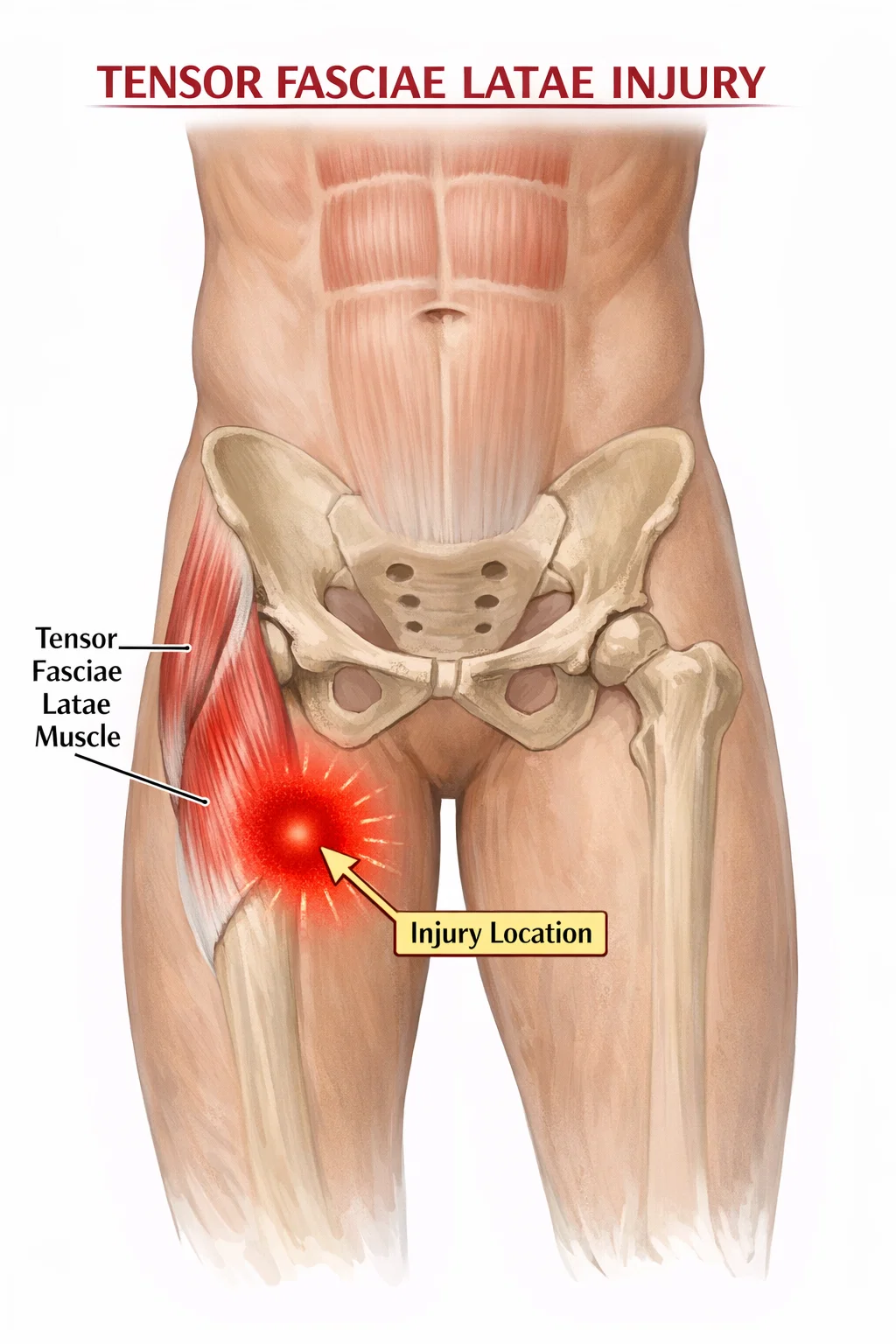
The tensor fasciae latae (TFL) is a small muscle at the outer front of the hip that helps flex and abduct the hip and blends into the iliotibial band. Pain in this area can come from the TFL, nearby tendons, the hip joint, or referred pain, so location alone cannot confirm a TFL injury. Use this guide to recognise patterns, adjust training load, and decide when an assessment is appropriate—not to self-diagnose.
01Signs & Symptoms
Symptoms that can occur with irritation around the TFL include:
- Pinpoint pain on the outer front hip, just below the iliac crest.
- Discomfort when lifting the knee, running uphill, or accelerating.
- Tightness or burning that spreads along the outer thigh or IT band.
- Hip tenderness when pressing into the muscle belly.
- Stiffness after sitting that eases once you warm up.
Location and triggers can guide a clinical assessment, but they do not reliably identify the injured structure on their own.
- Possible TFL involvement: localized outer-front hip pain that increases with resisted hip flexion or abduction.
- General hip flexor strain: deeper groin or front-hip pain that worsens with straight-leg raises.
- Glute medius or hip joint issues: side-hip ache that flares with single-leg stance or lying on the affected side.
- Referral patterns: diffuse pain into the groin, low back, or thigh can hint at non-TFL sources.
02Why It Happens
Outer-hip symptoms often follow a change in load rather than one isolated cause. The IOC consensus statement on training load and injury risk supports monitoring load alongside athlete wellbeing rather than treating one metric as a diagnosis. Relevant clues can include:
- A recent increase in speed work, hills, long-run distance, or total mileage.
- A new strength exercise, running surface, shoe, or gait change.
- Reduced recovery alongside higher training or life stress.
- Hip strength, movement control, or mobility limitations identified during an individual assessment.
These factors are associations and assessment prompts, not proof that one weakness or movement pattern caused the pain.
03Treatment Basics
Early management should reduce the aggravating load without defaulting to complete rest, then restore movement and strength gradually as symptoms allow, consistent with the BJSM PEACE & LOVE framework for soft-tissue injuries:
- Modify the trigger: Reduce or pause hills, speed, or distance that clearly worsens symptoms.
- Keep comfortable movement: Walking and pain-limited daily activity can help maintain function.
- Reload progressively: Begin with tolerable hip-strength exercises and progress resistance, range, and running demands one variable at a time.
- Use symptom response: Activity should not leave pain clearly worse overall or worse the next morning.
- Get an assessment when needed: A physiotherapist or sports-medicine clinician can test the hip and rule out other sources of pain.
04Should You Run?
Some runners can continue with a reduced, flat, easy run if their stride remains normal and symptoms settle quickly. NHS soft-tissue guidance advises adjusting pace, repetitions, or rest when pain rises and checking that activity does not leave symptoms worse the next morning.
- Stop or switch activity if pain changes your stride, increases as the run continues, or is worse the next morning.
- Use walking, pool running, cycling, or another comfortable option only if it does not aggravate symptoms.
- Resume with flat, easy running before reintroducing hills, speed, and longer duration.
- Seek prompt care after a traumatic injury, inability to bear weight, severe or worsening pain, marked swelling, fever, numbness, or night pain.
05Recovery Timeline
There is no reliable TFL-specific recovery timetable that applies to every runner. The Bern consensus statement on return to sport describes return decisions as multifactorial risk management. Progress depends on the actual diagnosis, symptom severity, training demands, and response to loading. Use function rather than a calendar: walking should be comfortable, easy running should not alter your stride, and symptoms should return to their usual baseline by the next morning before you add duration, hills, or speed.
If symptoms are not steadily improving, keep recurring, or restrict normal activity, arrange an assessment rather than extending a self-directed timeline.
06Strength and Return-to-Running Ideas
No single exercise or cadence prevents TFL pain. Once daily activity is comfortable, a clinician or coach may use exercises such as these to rebuild hip and single-leg capacity:
- Side‑lying hip abductions: Focus on the glute medius, toes slightly down.
- Monster walks: Light band tension, knees soft, pelvis level.
- Single‑leg Romanian deadlifts: Control hip hinge and avoid pelvic tilt.
- Split squats: Keep the front knee tracking over mid‑foot.
- Hip mobility: Use a comfortable range without forcing pain at the outer front hip.
- Running progression: Add duration, then hills or speed, based on symptoms and normal mechanics rather than chasing a universal cadence.
If pain persists beyond a couple of weeks, seek assessment from a sports medicine professional.
References and review
Editorial check completed by the RunCalcs Editorial Team: August 31, 2026. The guidance was checked against the authoritative sources listed below. This guide is educational and is not a substitute for diagnosis or personal medical advice.
- TFL and lateral-hip load-management discussion is informed by sports-medicine literature on iliotibial-band and hip-control factors, including Aderem and Louw's systematic review of biomechanical risk factors for iliotibial band syndrome in runners.
- Training-load discussion is checked against the IOC consensus statement on load in sport and injury risk.
- Soft-tissue care and progressive-loading advice is cross-checked against Dubois and Esculier's BJSM PEACE & LOVE soft-tissue injury editorial and NHS inform soft-tissue injury advice.
- Return-to-running caution is informed by 2016 BJSM consensus statement on return to sport and BJSM consensus statement on youth running.
Last updated: September 12, 2026
Disclaimer: This article is general information only and not medical advice. Seek professional care for persistent pain.
Learn how RunCalcs reviews health, injury, recovery, and nutrition content in our editorial source-check policy.