The half marathon is long enough to punish optimism and short enough to reward commitment. The best pacing plan is usually simple: choose a goal that matches current fitness, start a little calmer than pride wants, then let effort rise gradually over the final third.
Set a realistic goal pace
A standard half marathon is 21.0975 km, or 13.1094 miles. That precision matters because small pacing errors compound across the whole race. Ten seconds too fast per kilometre is roughly three and a half minutes by the finish.
Start with current evidence, not only a hopeful target:
- Recent race result: use a 5K, 10K, or previous half marathon in the Race Time Predictor.
- Training proof: goal pace should feel controlled in shorter blocks, such as 3 x 3 km or 2 x 5 km during peak training.
- Long-run base: if your long runs have been inconsistent, choose the conservative end of your predicted range.
- Course profile: hills, tight turns, wind, and crowding change effort even when the watch pace looks the same.
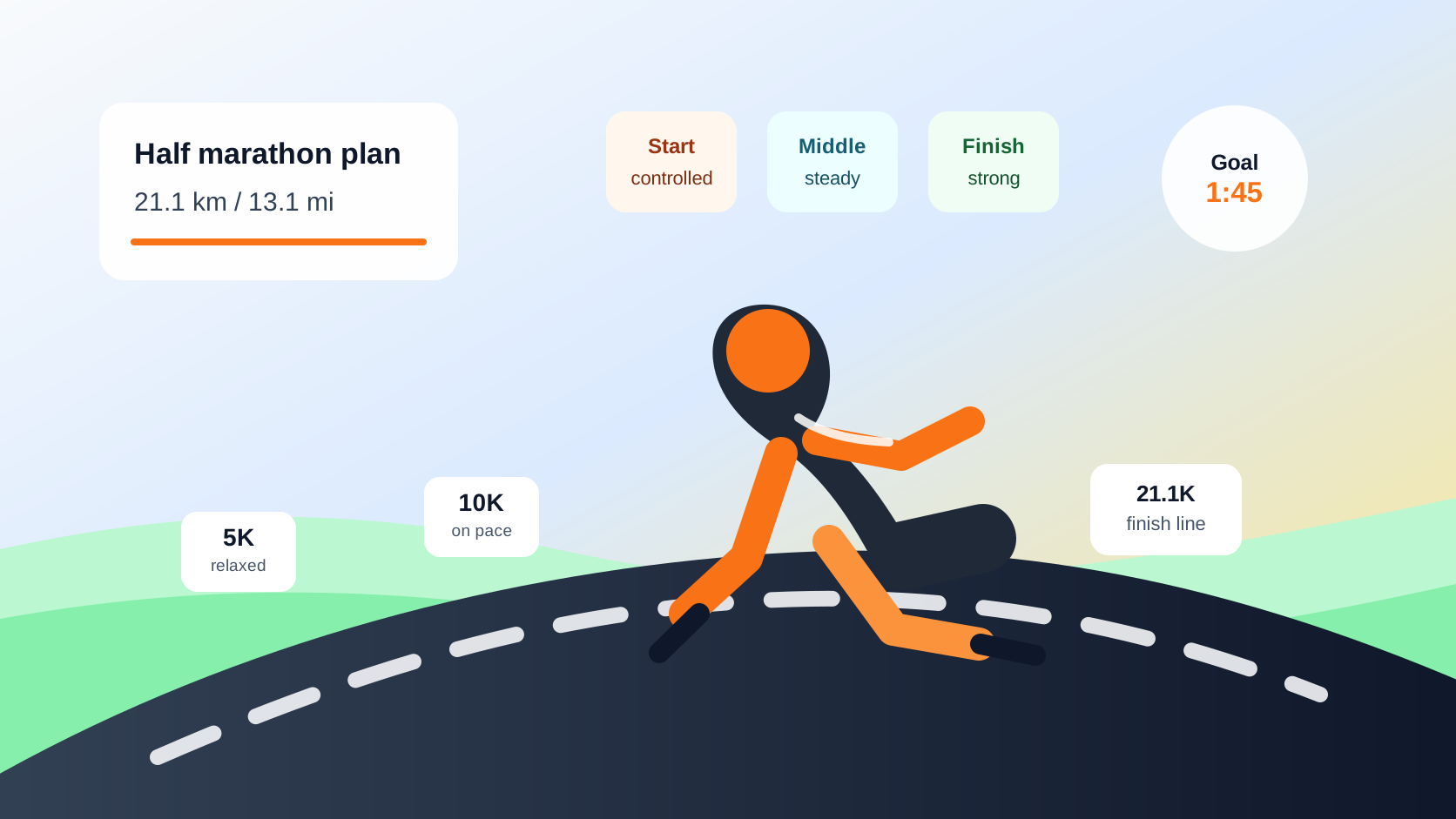
Once you have a target finish time, convert it into min/km and min/mile with the Pace Calculator. Then create a split band, not a single rigid number. A 1:45 half marathon, for example, averages about 4:59 per km or 8:01 per mile, but racing well may mean opening just slower than that and finishing just faster.
Use a three-part race plan
Half marathon pacing works best when the race has phases. The plan below uses effort and attention, not only watch pace, because GPS can be noisy around tall buildings, tree cover, and crowded turns.
0 to 5 km: protected effort
The opening should feel almost too easy. Hold back when faster runners surge away, take the cleanest line you can, and let the first kilometre settle before making any judgement. If you are 5 to 15 seconds slow at 5 km but relaxed, that is usually easier to fix than being too fast and breathing hard.
5 to 15 km: rhythm and restraint
This is the working section. Lock into goal effort, keep form quiet, and avoid chasing every small pace fluctuation. If you are passing runners gradually without surging, the plan is doing its job.
15 km to finish: controlled pressure
After 15 km, the race becomes more honest. If breathing and form are still under control, move from "hold pace" to "apply pressure." Do not sprint yet. The useful move is a firm, sustainable lift that you can carry through 20 km before emptying the tank near the finish.
Check your 5K splits
Short split checks stop the race from becoming a watch-refresh contest. Use the Splits Planner to create kilometre or mile splits, then remember a few larger checkpoints.
| Checkpoint | Even-split target | Good race cue |
|---|---|---|
| 5 km | 24:53 | Relaxed, not forcing the pace |
| 10 km | 49:46 | Breathing firm but controlled |
| 15 km | 1:14:39 | Ready to increase pressure |
| 20 km | 1:39:32 | Working hard, still moving well |
| Finish | 1:45:00 | No regrets left late |
For a slight negative split, let the first 5 km land a few seconds slower than even pace, bring the middle back to target, then ask for the faster running after 15 km. The difference should be subtle. A dramatic late charge usually means the opening was too cautious for your fitness.
Adjust on race day
A pacing strategy is a decision system, not a promise that conditions will behave. Decide your adjustments before the start so you are not negotiating with fatigue later.
- If the first kilometre is crowded: stay patient and recover the time gradually over the next 8 to 10 km.
- If there is a headwind: judge effort, tuck into groups when appropriate, and avoid forcing exact pace into the wind.
- If the course is hilly: let pace slow uphill and return on flatter or downhill sections without sprinting.
- If the watch GPS jumps: use official markers and average-lap pace rather than reacting to one strange split.
- If goal pace feels hard before 8 km: back off early. A controlled reset beats a long fade.
Write an A, B, and C goal before race morning. The A goal is the stretch target, the B goal is a solid result, and the C goal is the execution standard you can still be proud of if the day is slower than expected.
Common half marathon pacing mistakes
- Racing the first 3 km: early excitement can feel free, but the bill arrives after halfway.
- Using dream pace as training pace: current fitness is a better guide than the time you hope to run someday.
- Chasing pace on hills: even effort is usually smarter than exact pace on uneven courses.
- Ignoring the middle: many fades start with small surges between 6 km and 14 km, not only in the final miles.
- Waiting too long to commit: if you are still jogging comfortably at 18 km, you probably left too much out there.
Related tools and guides
- Pace Calculator
- Splits Planner
- Race Time Predictor
- Even Pace and Negative Splits
- Tempo Runs and Threshold Training
- How Long Should My Long Run Be?
- 5K and 10K Race Warm-Up
Sources and review
Last editorial source check: August 1, 2026. This race-planning guide is general education, not individual coaching or medical advice.
- The official half marathon distance is checked against World Athletics' half marathon event overview.
- Even-pacing guidance is informed by Abbiss and Laursen's review of pacing strategies during athletic competition.
- Half marathon performance and pacing observations are cross-checked against a large half-marathon participation and performance analysis.
- Training context for half marathon readiness is informed by research on training volume, longest runs, and half-marathon performance.
- Race-day adjustment advice is checked against a review of pace manipulation in endurance sport.
Last updated: September 12, 2026