A useful long-run fueling plan answers three questions: how many grams of carbohydrate you need each hour, which products or foods will supply them, and how you will spread those servings across the run. The numbers matter, but a plan only works when you have practised it and can tolerate it.
The quick answer: fuel by duration
The carbohydrate ranges below follow the duration-based approach used by the Australian Institute of Sport sports-gel guidance. They describe carbohydrate consumed during exercise, not everything you should eat that day.
| Planned run time | Carbohydrate during the run | Practical approach |
|---|---|---|
| Under 45 minutes | Usually not needed | Start normally fuelled; water may be enough |
| 45–75 minutes | Small amounts or a carbohydrate mouth rinse may help hard efforts | Optional; do not force a gel into every easy run |
| More than 75 minutes to 2.5 hours | 30–60 g per hour | Build a repeatable schedule from product labels |
| More than 2.5 hours | Up to 90 g per hour when practised and tolerated | Use multiple carbohydrate sources and build gradually |
These are ranges, not a command to consume the maximum. Duration, intensity, what you ate beforehand, race goals, access to aid stations, and gut tolerance all change the sensible target. A new runner doing an easy two-hour session might begin around 30 g/hour; a trained marathoner may practise substantially more for race day.
Turn the target into a carrying plan
Use the Run Fuel Calculator to select a target range from your expected duration. Enter the carbohydrate in one serving of your chosen gel, chew pack, bar, or measured drink to estimate how many servings to carry.
- Estimate the total time you expect to be running, including a realistic allowance for hills, heat, or race congestion.
- Choose a starting point within the calculator's hourly range.
- Add the carbohydrate supplied by every planned product.
- Divide the total across the run so intake is regular rather than back-loaded.
- Carry a small reserve when a missed aid station or dropped gel would otherwise break the plan.
For example, a two-hour run at 40 g/hour requires about 80 g in total. Four 20 g servings or three servings of roughly 27 g both reach that target. The best combination is the one you can carry, open, swallow, and tolerate while moving.
When should you start fueling?
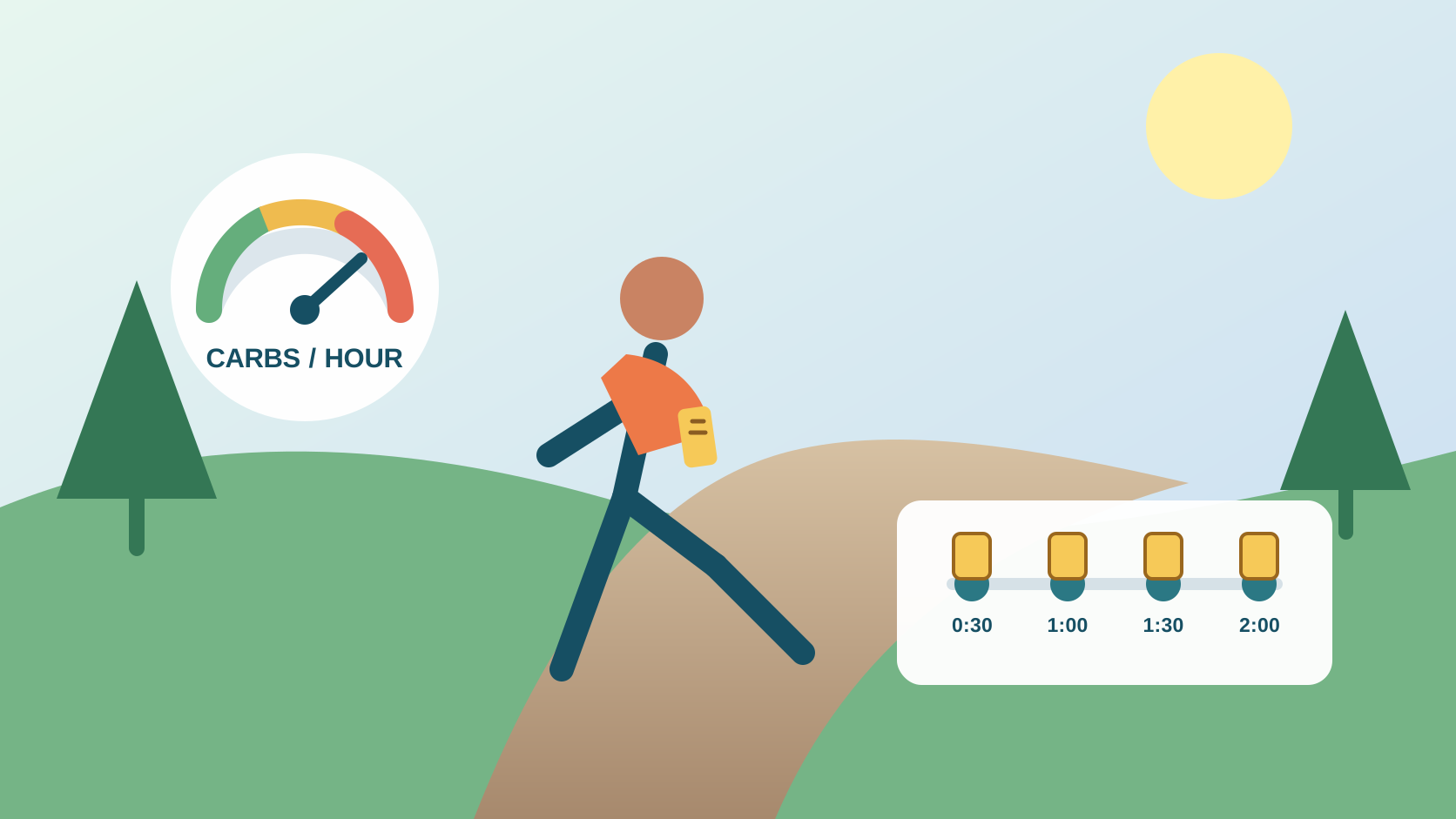
Do not wait until you feel empty. By the time pace is fading or hunger is obvious, it may be difficult to catch up without taking a large amount at once. For a run that needs carbohydrate, a practical starting pattern is a first serving around 20–30 minutes, followed by smaller regular servings that deliver the hourly target.
Timing comes from the serving size. If a gel contains 25 g and the target is 50 g/hour, one gel every 30 minutes supplies the planned rate. If a chew portion contains 10 g, taking one about every 12 minutes produces the same average. You do not need stopwatch precision: use aid stations, trail landmarks, or watch alerts to make the plan easy to remember.
The World Athletics nutrition consensus statement supports carbohydrate intake matched to event demands and notes the benefit of frequent carbohydrate exposure during longer endurance events.
Gels, chews, sports drink, or real food?
| Fuel source | Strengths | Watch for |
|---|---|---|
| Gels | Compact, labelled, quick to take | Many need water; thick texture or sweetness may become tiring |
| Chews | Easy to split into small doses | Require chewing and can be awkward in cold weather |
| Sports drink | Delivers fluid and carbohydrate together | Drinking more in heat also raises carbohydrate intake |
| Bars or soft solids | More flavour and texture variety | Slower to eat; fat, fibre, or protein may reduce tolerance at race pace |
| Simple foods | Familiar and often inexpensive | Portion size and carbohydrate content need calculating |
For prolonged exercise above 60 g/hour, sports-nutrition guidance commonly recommends products containing multiple transportable carbohydrates, such as glucose plus fructose, because they use more than one intestinal transport pathway. The Academy of Nutrition and Dietetics, Dietitians of Canada, and ACSM position statement describes carbohydrate intake up to 90 g/hour for extended high-intensity endurance exercise using mixed carbohydrate sources.
Sports products are convenient, not compulsory. A banana, white-bread jam sandwich, rice cake, dried fruit, or confectionery can contribute carbohydrate if it is practical to carry and agrees with you. At faster race intensities, lower-fibre and lower-fat options are usually easier to digest. Test exact products, flavours, and packaging in training.
Worked long-run fueling plans
These examples demonstrate the arithmetic. They are starting plans rather than personalised prescriptions, and the targets deliberately begin below the maximum for each duration.
| Run | Example target | Total carbohydrate | Example schedule |
|---|---|---|---|
| 90 minutes | 30 g/hour | 45 g | 15 g at 25, 50, and 75 minutes |
| 2 hours | 45 g/hour | 90 g | About 22–23 g every 30 minutes |
| 3 hours | 60 g/hour | 180 g | 30 g every 30 minutes |
| 4 hours | 75 g/hour | 300 g | 25 g every 20 minutes, using mixed carbohydrate sources |
The four-hour example is an advanced intake. It should be reached through repeated practice, not attempted for the first time during a marathon. If a session target feels too ambitious, reduce the rate, use smaller and more frequent portions, or try another product format before increasing again.
What to eat before a long run
The goal of the pre-run meal is to begin with carbohydrate available without creating avoidable stomach problems. The joint sports-nutrition position statement recommends roughly 1–4 g of carbohydrate per kilogram of body mass in the 1–4 hours before exercise, with the amount and timing adjusted to the athlete and the event. That is a wide range because a small snack one hour before a run is very different from a substantial meal four hours before it.
- Three to four hours before: a familiar carbohydrate-rich meal such as cereal with milk and fruit, toast with eggs and fruit, or rice with a light topping.
- One to two hours before: a smaller option such as toast with jam, a banana, a low-fibre cereal bar, or a sports drink.
- Very early starts: use the smallest familiar snack you tolerate, then begin the on-run plan early rather than forcing a large breakfast.
Reduce unusually fatty, high-fibre, spicy, or very large meals close to the run if those foods have caused symptoms before. “Never try anything new on race day” applies to breakfast as much as it applies to gels.
Fuel and hydration are related but not identical
Carbohydrate targets do not tell you how much to drink. Fluid needs change with weather, pace, body size, clothing, sweat rate, and access to water. Read the Hydration for Runners guide to build a separate drinking plan.
Count carbohydrate from sports drink toward the hourly fuel target. If 500 mL of drink supplies 30 g and you consume it in one hour, only another 20 g is needed to reach a 50 g/hour plan. This avoids accidentally stacking a full gel plan on top of a full carbohydrate-drink plan.
Train your gut as well as your legs
Gastrointestinal symptoms are common in endurance sport, but race day is not the place to discover your limit. A review of gastrointestinal assessment and management in endurance athletes describes how nutrition strategies and repeated practice can influence symptoms and tolerance.
- Begin near the lower end of the appropriate carbohydrate range.
- Repeat the same rate on several long runs before increasing it.
- Increase one variable at a time: grams per hour, serving frequency, product type, or concentration.
- Practise at race pace as well as easy pace because intensity can change tolerance.
- Record the product, amount, timing, fluid, weather, and any nausea, bloating, cramping, or urgency.
If symptoms persist, first check simple causes: an unexpectedly concentrated drink, gels without enough water, a large pre-run meal, high fibre or fat close to the run, dehydration, excessive fluid, or a sudden jump in carbohydrate intake. Recurrent or severe symptoms deserve assessment from a doctor or accredited sports dietitian rather than endless product swapping.
What to eat after the run
A normal meal containing carbohydrate, protein, and fluid is enough after many long runs. Recovery becomes more time-sensitive when another demanding session is scheduled within roughly eight hours. The joint sports-nutrition position statement recommends aggressive early carbohydrate replacement when rapid glycogen restoration is necessary; most recreational runners can instead eat a familiar balanced meal soon after finishing and continue normal meals across the day.
Examples include cereal, milk, and fruit; a rice bowl with eggs or lean protein; a sandwich with yoghurt and fruit; or a smoothie alongside toast. Replace fluid gradually, and include sodium through ordinary food or an appropriate drink when the run was long, hot, or particularly sweaty.
Common long-run fueling mistakes
- Starting too late: waiting for fatigue leaves little time for the plan to help.
- Counting products instead of grams: five gels can mean very different carbohydrate totals.
- Ignoring carbohydrate in drink: liquid fuel belongs in the hourly total.
- Jumping straight to 90 g/hour: the top of the range is not a beginner target.
- Using a short easy run as a fueling rule: most routine runs under an hour do not require an on-run feeding schedule.
- Changing everything at once: when a plan fails, you cannot identify the cause.
- Practising only at easy pace: race effort can change how quickly and comfortably you can eat and drink.
- Depending entirely on aid stations: know what the event supplies, where it appears, and what you will carry as backup.
Long-run fueling FAQs
Do I need a gel for a 60-minute run?
Usually not for an ordinary easy run when you begin normally fuelled. A small amount may help a hard session, an under-fuelled early start, or one part of a longer training day, but it is not a requirement for every hour of running.
How many gels do I need for a two-hour run?
A two-hour run sits in the 30–60 g/hour band, giving 60–120 g in total. If one gel supplies 25 g, that is about three to five gels. A first attempt should normally begin toward the lower end and be adjusted through training.
Can I fuel a marathon with sports drink alone?
Possibly, if the drink volume required to reach your carbohydrate target also suits your fluid needs and you tolerate it. In practice, many runners combine drink with gels, chews, or food so fluid can change with conditions without breaking the fuel plan.
Is 90 g of carbohydrate per hour better than 60 g?
Not automatically. Ninety grams per hour is an upper target for prolonged endurance exercise, not a universal goal. The extra carbohydrate is useful only when the duration, intensity, performance goal, and trained gut tolerance justify it.
Should I use the same plan in training and on race day?
Use key long runs to rehearse the race products, breakfast, timing, carrying method, and approximate intake. An easy long run does not have to copy every race detail, but nothing important should appear for the first time on race morning.
Sources and review
Last editorial source check: November 7, 2026. This guide was checked by the RunCalcs Editorial Team. It provides general sports-nutrition education and is not individual medical or dietetic advice.
- Duration-based carbohydrate targets and sports-food use are checked against the Australian Institute of Sport sports-gel guidance.
- Event-specific carbohydrate intake and frequent intake during longer endurance events are checked against the World Athletics consensus statement on nutrition for athletics.
- Pre-exercise meals, carbohydrate during exercise, mixed carbohydrate sources, and rapid recovery guidance are checked against the Academy of Nutrition and Dietetics, Dietitians of Canada, and American College of Sports Medicine position statement.
- Gastrointestinal symptom management and gut-training context are informed by a peer-reviewed review of gastrointestinal assessment and management in endurance athletes.
Health-adjacent content follows the RunCalcs editorial source-check policy.
Published: November 7, 2026