Treadmill incline is best treated as an effort control, not a pace penalty you must defeat. A small change in grade can move an easy run toward threshold effort even when the belt speed stays fixed.
Why incline raises running effort
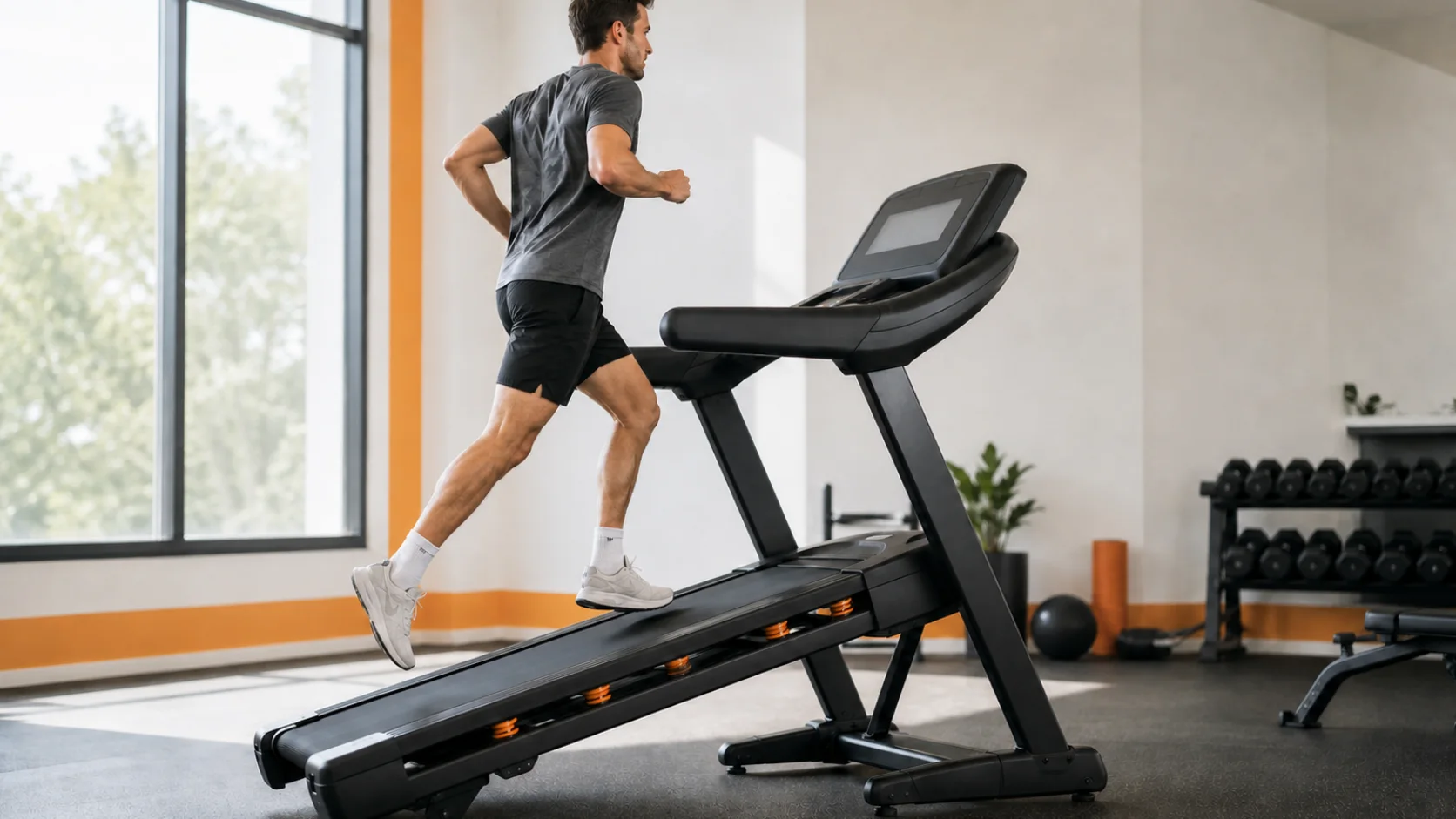
On a level treadmill, most of the metabolic demand comes from moving at the selected belt speed. Raising the deck adds vertical work. The runner must gain height with each stride, so oxygen demand rises even if speed stays unchanged.
The ACSM running equation represents that demand with horizontal, vertical, and resting components:
Estimated VO2 = (0.2 x speed) + (0.9 x speed x grade) + 3.5
Speed is measured in metres per minute and grade is written as a decimal, so 5% becomes 0.05. This is a population equation, not a direct measurement. It is most accurate at running speeds above about 5 mph (8 km/h), and it assumes steady running without handrail support.
Laboratory research confirms the broad direction of the model: the energy cost of running rises as positive slope increases. In a study of ten runners across unusually wide gradients, uphill energy cost increased substantially with grade, while very steep slopes changed the economics of walking and running in more complex ways. That is why the RunCalcs tool stops at 10% rather than pretending one linear conversion remains equally useful at extreme grades. See Minetti et al., Journal of Applied Physiology.
Outdoor flat and ACSM treadmill equivalents
The calculator presents two estimates because they answer different questions. The Outdoor flat equivalent uses a simple 3%-per-grade training heuristic. At 5:00/km and 5%, it returns 4:21/km. This matches the common road-effort conversion style but should not be mistaken for a direct physiological measurement.
The conversion has two steps. First, estimate oxygen demand at the chosen speed and incline. Second, solve the same equation at 0% grade for the speed that produces that estimated demand.
For example, 12 km/h equals 5:00/km. At 5% incline, the equation estimates 52.5 mL/kg/min. On a level treadmill, the equation reaches the same demand at 14.7 km/h, or about 4:05/km.
That does not mean the runner has demonstrated either equivalent pace as race fitness. The outdoor figure is a heuristic and the ACSM figure describes estimated demand between inclined and level treadmill running. At higher grades, muscular fatigue, stride changes, treadmill familiarity, and individual uphill economy become more important.
A 2022 validation study tested experienced runners across speed-incline combinations designed to be equivalent. Combinations from 0% to 4% produced broadly similar measured responses, but meaningful differences appeared at 6% and above. The paper supports using conversion charts and equations as estimates, especially at modest grades, rather than exact prescriptions. See the open-access validation study.
Does 1% treadmill incline equal outdoor running?
Sometimes it is a useful approximation, but it is not a universal rule.
The familiar recommendation comes from a 1996 study that compared outdoor and treadmill oxygen cost at speeds from 2.92 to 5.0 m/s, roughly 10.5 to 18 km/h. In that protocol, a 1% treadmill grade most closely matched outdoor energetic cost over runs of about five minutes. Read Jones and Doust's original study.
The finding is often stretched beyond its evidence. Slower running, still air, treadmill belt and deck characteristics, heat, and an individual's economy can change the comparison. Another study using a broader speed range found 0.4% was suitable for its particular protocol, illustrating that one setting cannot reproduce every outdoor condition. See the open-access treadmill testing study.
Most importantly, the 1% question and the incline-effort calculator answer different questions:
- 1% rule: tries to compensate for differences between treadmill and outdoor running, particularly air resistance at faster speeds.
- Outdoor flat heuristic: adds 3% effort per incline point to provide a practical road-style comparison.
- ACSM incline conversion: compares one treadmill speed-grade combination with a level treadmill metabolic estimate.
How to choose treadmill speed and grade
Choose the session's purpose first. Then use incline to shape effort while preserving good mechanics.
- Easy running: 0% to 2%. Keep breathing conversational; do not add grade just to make the treadmill feel harder.
- Rolling-hill simulation: alternate 1% to 4% blocks while adjusting speed enough to keep the intended effort.
- Controlled hill repeats: 4% to 7% for 30 seconds to 3 minutes, with an easy jog or walk recovery.
- Steep strength intervals: 8% to 10% at a slower belt speed and shorter duration. Stop treating flat pace as the target.
When the calculated ACSM equivalent pace looks surprisingly fast, use it as context, not a command. The calculator's comparison table is useful for scanning how the same belt speed changes across grades, while breathing, heart rate, and repeat quality should decide whether to increase or reduce speed.
Three treadmill incline workouts
Introductory rolling run
- 10 minutes easy at 0% to 1%.
- 6 x 2 minutes at 3%, with 2 minutes easy at 0% to 1%.
- Keep the speed steady only if effort remains controlled.
- 10 minutes easy cooldown.
5K to 10K hill-strength session
- 15 minutes easy, then 3 short strides.
- 8 x 60 seconds at 5% to 6% and a hard, repeatable effort.
- Take 90 seconds easy at 0% to 1% between repeats.
- Finish with 10 to 15 minutes easy.
Long climbing intervals
- 15 to 20 minutes easy.
- 4 x 4 minutes at 3% to 5% around controlled threshold effort.
- Recover for 2 minutes easy between repetitions.
- Reduce speed if the final interval would require rail holding or a major form change.
Outdoor hills add downhill running and changing terrain, so treadmill incline is not a complete replacement. Pair indoor sessions with the Hill Repeats for Runners guide when preparing for a hilly race.
Form and safety on an incline
- Use a small whole-body lean from the ankles rather than bending sharply at the waist.
- Shorten stride naturally as grade increases and keep the feet landing under the body.
- Avoid pulling on the handrails. Slow the belt or lower the incline instead.
- Build grade and duration progressively, particularly if the calves or Achilles tendons are not used to hill running.
- Use the safety clip and leave enough space behind the treadmill.
If pain changes your stride, stop the workout. Incline running changes tissue demand, and a calculator cannot determine whether a setting is appropriate during injury or rehabilitation.
Why treadmill and outdoor running are not identical
A treadmill controls belt speed and removes route variation, but it does not reproduce every outdoor demand. A 2020 systematic review of 33 crossover studies found that most biomechanical outcomes were broadly comparable, while several foot-strike, knee, contact-time, and propulsive-force measures differed. The evidence supports treadmill running as a useful training mode without treating it as mechanically identical to overground running. See the systematic review and meta-analysis.
Practical sources of error include:
- Belt speed and incline calibration.
- Air movement and gym temperature.
- Treadmill deck stiffness and belt dimensions.
- Rail holding, position on the belt, and familiarity.
- Individual uphill running economy and fatigue.
Use repeatable settings on the same treadmill when tracking progress. That comparison is usually more useful than debating whether one conversion is exact to the second per kilometre.
Related tools and guides
- Treadmill Incline Effort Calculator
- Running Pace Calculator
- Heart-Rate Zones Calculator
- Hill Repeats for Runners
- Interval Training for Runners
- Running Technique and Economy
References and editorial review
Editorial check completed by the RunCalcs Editorial Team: 19 August 2026. This article follows the RunCalcs editorial source-check policy. It has not been medically or clinically reviewed.
- Ludwig et al. Assessment of a Treadmill Speed Incline Conversion Chart: A Validation Study.
- Minetti et al. Energy cost of walking and running at extreme uphill and downhill slopes.
- Jones and Doust. A 1% treadmill grade most accurately reflects the energetic cost of outdoor running.
- Van Hooren et al. Is Motorized Treadmill Running Biomechanically Comparable to Overground Running?
Training examples are general education, not individual coaching or medical advice.
Published: August 19, 2026