VO₂ max is the maximum rate at which your body can take in oxygen, deliver it to working muscle, and use it to produce aerobic energy. It is a genuine physiological limit—but it is not a complete score for running ability, health, or potential.
The short version
- What it measures: the highest rate of oxygen use reached during severe whole-body exercise.
- Usual unit: mL of oxygen per kg of body mass per minute (mL/kg/min).
- Why it matters: it is an important component of endurance performance and a strong marker of cardiorespiratory fitness.
- Best measurement: a progressive exercise test with breath-by-breath gas analysis, ideally with a verification stage when scientific precision is required.
- Watch value: a modelled estimate based largely on the relationship between external work (such as pace) and internal response (heart rate).
- Best way to use it: follow a trend measured by the same method, not a single reading or a comparison between devices.
What does VO₂ max actually mean?
The notation is compact. V̇ means a rate or volume per unit of time; O₂ is oxygen; and max means the maximum value achieved under the test conditions. In running articles the dot is often omitted and the term is written simply as VO2 max.
Oxygen uptake can be reported in two ways:
- Absolute VO₂ max, in litres per minute (L/min), describes the total volume of oxygen used. Larger people often have a higher absolute value because they have more metabolically active tissue.
- Relative VO₂ max, in millilitres per kilogram per minute (mL/kg/min), divides oxygen uptake by body mass. This is the number usually shown by running watches and fitness tables because running requires moving body mass.
Relative scaling is useful, but dividing by kilograms does not make every comparison perfectly fair. Body composition and the mathematical relationship between size and physiology matter. A change in relative VO₂ max can also come from a change in the numerator, the denominator, or both: oxygen use may rise, body mass may fall, or both may change.
The physiology: delivery multiplied by extraction
The Fick principle is the cleanest way to understand the number. Oxygen uptake equals cardiac output multiplied by the difference between the oxygen content of arterial blood entering the working muscles and venous blood leaving them. Cardiac output is heart rate multiplied by stroke volume.
This is the Fick equation expanded so that cardiac output becomes heart rate × stroke volume. See the physiological discussion in Poole and Jones.
Why VO₂ max is important—and why it is not everything
It sets the size of the aerobic engine
A higher VO₂ max gives an athlete a larger capacity for aerobic energy production. That matters in events lasting from several minutes to many hours. At the same absolute pace, a runner with a larger aerobic capacity can often operate at a lower fraction of maximum.
It is a strong health marker
Cardiorespiratory fitness is consistently associated with cardiovascular health and long-term mortality risk. The American Heart Association scientific statement argues that fitness has enough clinical and prognostic value to be treated as a vital sign. This is an association at population level, not a diagnosis from one watch number.
It does not determine race performance by itself
Two runners with the same VO₂ max can race very differently. Performance also depends on:
- Fractional utilisation: how much of VO₂ max can be sustained without accumulating fatigue too quickly.
- Running economy: the oxygen cost of a given speed. The economical runner uses less oxygen at the same pace.
- Durability: how well physiology and mechanics resist deterioration late in a long event.
- Anaerobic capacity and speed: especially important in shorter races, hills, surges, and finishes.
- Pacing, heat tolerance, fuelling, biomechanics, psychology, and race skill.
Think of VO₂ max as the engine's maximum aerobic throughput. Threshold and economy help decide how much useful speed that engine produces, and endurance decides how long the system stays efficient.
Ways to measure or estimate VO₂ max
| Method | What it observes | Strength | Main limitation |
|---|---|---|---|
| Laboratory CPET | Breath-by-breath O₂ and CO₂ during progressive exercise | Direct physiological measurement under controlled conditions | Cost, access, test effort, protocol and equipment error |
| Maximal field test | Distance, time or final speed in a standard protocol | Accessible and sport-specific | Equation-based estimate; pacing, motivation and conditions matter |
| Submaximal test | Heart-rate response at known workloads | Lower effort and often safer or more repeatable | Extrapolates to a predicted maximum and often assumes a heart-rate relationship |
| Race-result model | Performance over a known distance | Uses meaningful real-world running data | Reflects economy, pacing and course conditions as well as aerobic capacity |
| Running watch | Heart rate, speed/motion and personal data during daily activity | Frequent, convenient trend monitoring | Proprietary model; it never measures respiratory gases |
Direct laboratory testing
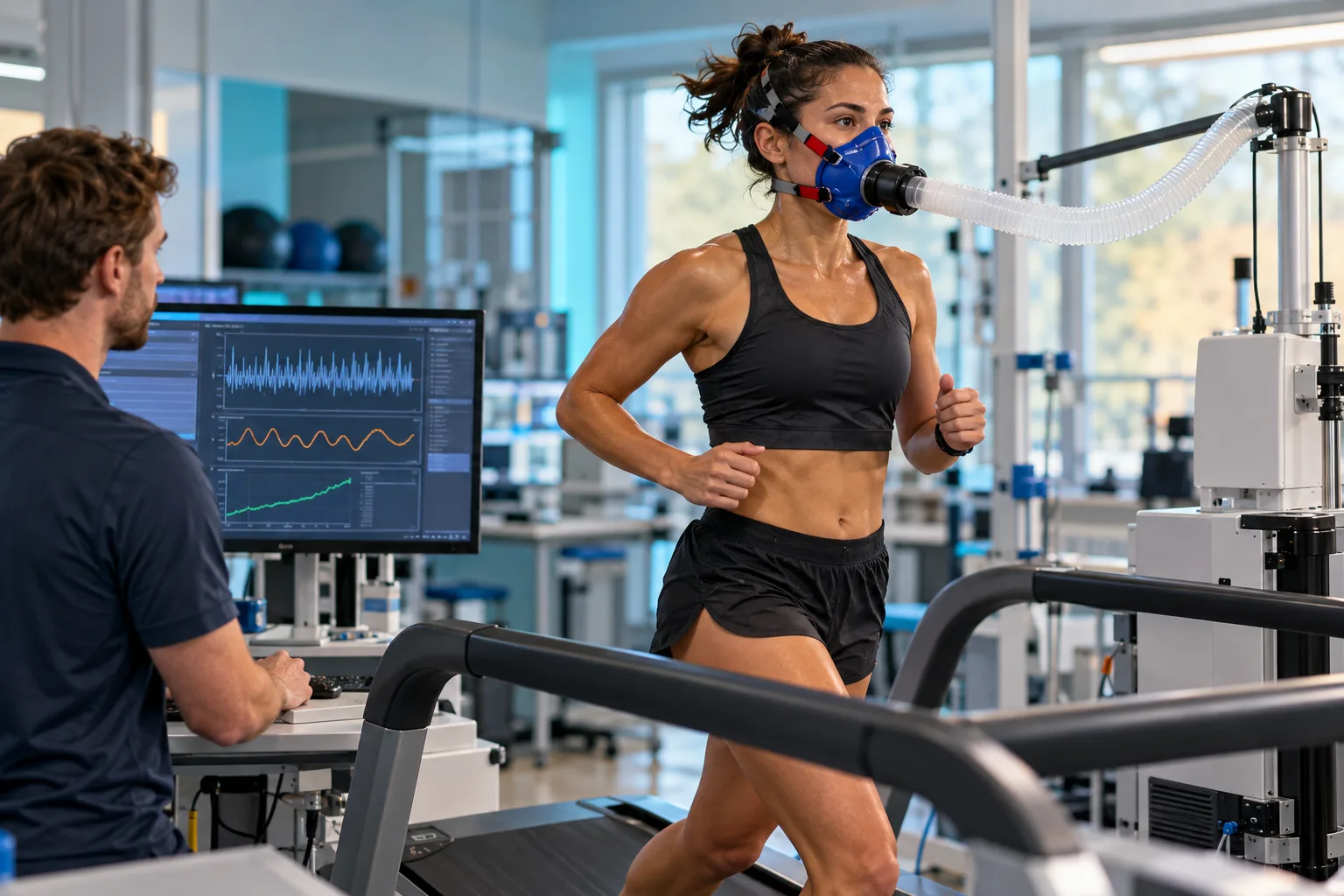
In a cardiopulmonary exercise test (CPET), workload rises in stages or as a continuous ramp while a metabolic cart measures ventilation and the oxygen and carbon-dioxide fractions in expired air. The analyser calculates oxygen uptake breath by breath. The highest credible value is reported as VO₂ max or, when maximality is not confirmed, VO₂ peak.
A visible plateau in oxygen uptake despite a further rise in workload is the classic evidence of VO₂ max, but a plateau is not always seen in a rapid ramp test. Heart-rate percentage, respiratory exchange ratio, blood lactate and perceived exertion are useful context, yet none proves maximality by itself. Researchers may add a short verification bout above the final ramp workload; a similar value supports the conclusion that the maximum was reached. This distinction and verification approach are discussed in Midgley and colleagues' recommendations.
Results are protocol-specific. A runner may obtain a different value on a cycle ergometer because the muscle mass and skill demands differ. Calibration, mask leaks, stage duration, familiarisation, recent training, altitude, temperature, illness, sleep and willingness to continue can all influence the test.
Field tests and prediction equations
Common approaches include a 12-minute run, 1.5-mile time trial, multistage shuttle test and submaximal step or treadmill protocols. These do not sample respiratory gases; they insert performance or heart-rate data into an equation derived from a reference group. They can be useful when repeated consistently, but an estimate is only as transportable as the population, assumptions and conditions behind its equation.
The RunCalcs VO₂ max calculator includes common field-test and race-performance methods. Keep the method the same if the purpose is to track change.
How a running watch estimates VO₂ max
A watch cannot measure oxygen consumption. It has no gas analyser and does not know the oxygen concentration or total volume of each breath. Instead, it models the relationship between external work and internal response: broadly, how fast you run compared with how hard your cardiovascular system appears to be working.
The common modelling logic
- Collect signals. Optical or chest-strap heart rate measures internal response; GPS, an accelerometer or a foot pod estimates speed and distance. Some devices use elevation.
- Add personal context. Age, sex, height, mass, resting heart rate, maximum heart rate and medication settings may constrain or adjust the prediction.
- Find usable sections. Algorithms may prefer steady, sufficiently hard running and reject stops, poor sensor contact, implausible GPS changes or steep terrain.
- Relate pace to physiological strain. Running speed has an expected oxygen cost, while heart rate indicates the fraction of cardiovascular capacity being used. The model fits or extrapolates that relationship toward a predicted maximum.
- Stabilise the output. Some systems combine several sessions or weight recent high-quality observations so that one noisy run does not completely rewrite the estimate.
This description is not guesswork about one brand. Firstbeat's published method describes segmenting heart-rate and speed data, rating reliability and using the strongest segments in a physiological model. Garmin's support criteria require qualifying outdoor running with GPS and elevated heart rate on many devices. Apple states that its cardio-fitness estimate uses heart and motion sensors plus profile and medication information during supported outdoor activities. Polar's Running Index paper describes an estimate based on speed and heart rate, with altitude used where available.
Why the estimate can be wrong
- Heart-rate error: loose fit, cold skin, motion artefact and cadence lock can distort optical readings.
- Wrong maximum heart rate: if the model thinks your maximum is lower or higher than it really is, the same working heart rate is assigned the wrong relative intensity.
- GPS or pace error: tall buildings, tree cover, tunnels, sharp turns and short intervals can corrupt speed.
- Environment: heat, humidity, altitude and headwind raise heart rate or change pace without necessarily reflecting a change in underlying VO₂ max.
- Cardiovascular drift: heart rate often rises during prolonged running even when pace does not.
- Terrain and surface: hills, trails, sand and soft ground alter oxygen cost relative to flat-road pace.
- Fatigue, illness, dehydration, caffeine and stress: all can change heart rate for a given pace.
- Running economy: a model may interpret an unusually economical or uneconomical heart-rate-to-speed relationship as aerobic capacity.
- Medication or medical conditions: beta blockers and other factors that blunt heart rate can break ordinary assumptions. Apple specifically warns that heart-rate-limiting conditions or medication can lead to overestimation.
Validation studies show why the word estimate matters. In one multi-device study, individual error varied even when group averages looked acceptable; the authors concluded that wearables were more defensible for monitoring than for replacing criterion testing (Passler et al.). A watch number should therefore be treated as a model output with uncertainty, not a blood-test-style measurement.
Make a watch trend more useful
- Keep body mass, age, medication and heart-rate settings current.
- Use a snug sensor fit; use a compatible chest strap when heart-rate accuracy matters.
- Give the device regular steady outdoor runs on reasonably flat ground.
- Compare rolling trends on the same device, not isolated readings across brands.
- Annotate heat, altitude, illness and unusually fatigued runs before interpreting a dip.
- Confirm an unexpectedly important result with a standard field test or laboratory assessment.
How to improve VO₂ max
The central requirement is progressive aerobic overload followed by enough recovery to adapt. Both continuous endurance training and high-intensity intervals can improve VO₂ max. An overview of systematic reviews found benefits across intensity ranges, while higher intensities often produced a larger or more time-efficient stimulus; results varied with baseline fitness, program design and population (Rosenblat and colleagues).
1. Build enough easy aerobic volume
Easy running supports the training volume required to develop mitochondrial density, capillarisation, plasma volume, connective-tissue tolerance and fatigue resistance without making every session costly. It also makes hard sessions repeatable. New runners can improve VO₂ max substantially from consistent easy-to-moderate running alone.
2. Add work near maximal aerobic intensity
Intervals allow more accumulated time at a high oxygen uptake than one continuous all-out effort. Productive formats include:
- Long intervals: 4–6 × 3–5 minutes at roughly current 3K–5K effort, with 2–3 minutes of easy jogging.
- Short intervals: 10–16 × 1 minute hard with 1 minute easy, useful for introducing intensity while controlling each repetition.
- Uphill intervals: 6–10 × 60–120 seconds at a strong controlled effort, jogging easily down.
Pace is a guide, not a command. The aim is repeatable severe-intensity work with good mechanics—not sprinting the first repetition. Heart rate lags behind effort, so it is better for reviewing the set than controlling the opening minute. A meta-analysis of controlled trials found both interval and continuous endurance training effective, with interval training producing a modestly greater average VO₂ max improvement in the studied healthy adults (Milanović et al.).
3. Keep threshold, strides and strength in the wider plan
Threshold training may not push oxygen uptake to maximum in every session, but it improves the fraction of aerobic capacity that can be sustained. Strides preserve speed and mechanics. Strength training can support force production and running economy. These qualities help turn a larger VO₂ max into faster racing.
4. Progress the dose, not just the pain
Start with one hard aerobic session per week if you are new to intervals. Add repetitions or total time before making every repetition faster. Experienced runners often use one VO₂-oriented workout alongside a threshold session, but only when their volume, recovery and injury history support it. The interval training guide explains how to scale sessions; the easy run guide helps protect the rest of the week.
Example week for a runner already training consistently
This is an example structure, not an individual prescription. Do not add two hard days to a week that does not yet support them. Stop exercise and seek medical care for chest pain, fainting, or unusual severe breathlessness; discuss maximal testing or intense training with a qualified clinician if you have relevant symptoms or cardiovascular risk.
How VO₂ max changes with age
VO₂ max typically rises through childhood and adolescence, reaches its highest population values in early adulthood, and then declines with age. There is no single universal percentage loss per decade. Cross-sectional tables compare different people at one point in time; longitudinal studies follow the same people and can show a different, often nonlinear pattern.
Why it tends to decline
- Maximum heart rate falls. Because heart rate is one component of maximum cardiac output, this reduces the ceiling even when training continues.
- Maximum stroke volume and blood delivery may decline. Changes in cardiac filling, vascular function and blood volume contribute.
- Active muscle mass and peripheral extraction change. Sarcopenia, capillary and mitochondrial changes, and reduced muscle oxidative capacity matter.
- Body composition can change. For relative VO₂ max, an increase in non-functional mass lowers mL/kg/min even if absolute oxygen use changes less.
- Training often changes. Reduced volume, intensity, frequency, injury interruptions and less day-to-day activity amplify biological ageing.
A small longitudinal cohort of older male endurance athletes showed why training history matters: those who maintained vigorous training had little observed decline during follow-up, while athletes who reduced training declined faster (Trappe et al.). This does not mean everyone can prevent decline, and the subgroup that maintained training was small. It does show that an age trend mixes primary ageing with changes in training stimulus.
For a population comparison, use the RunCalcs VO₂ max by age dataset. It reports survey-weighted estimated percentiles from 5,515 US NHANES participants aged 12–49 and clearly distinguishes those submaximal estimates from direct laboratory measurement.
How to interpret your own number
- Name the method. “52 from my watch” and “52 from treadmill gas analysis” are not interchangeable observations.
- Check the unit. Most comparisons use mL/kg/min, but laboratories may also report L/min.
- Compare like with like. Use the same device, activity mode, terrain and broad conditions where possible.
- Look at a block, not a day. A four- to eight-week trend is more informative than one hot, hilly or fatigued run.
- Pair it with performance. Race results, threshold pace, easy-run heart rate, training consistency and how you feel complete the picture.
- Do not chase the metric at any cost. Faster racing can occur with a stable VO₂ max through improvements in economy, threshold, durability and pacing.
Common VO₂ max questions
Is a high VO₂ max always better?
Higher aerobic capacity is generally advantageous for endurance sport and is associated with better health outcomes, but context matters. It does not erase injury risk, symptoms, poor recovery or other health measures, and it does not rank every runner's race ability perfectly.
How quickly can VO₂ max improve?
Measurable changes can occur over several weeks, especially in people starting from a lower training base. The response varies with baseline fitness, genetics, training dose, adherence, recovery and measurement noise. Highly trained runners usually have less room for large percentage gains.
Why did my watch VO₂ max fall after an easy run?
The device may have observed a higher heart rate than expected for the pace. Heat, hills, fatigue, dehydration, sensor error, cardiac drift or a wrong maximum-heart-rate setting can all create that pattern. One reading is weak evidence of lost fitness.
Can losing weight increase relative VO₂ max?
Mathematically, yes: if absolute oxygen uptake stays constant while body mass falls, mL/kg/min rises. But weight loss can also reduce health, recovery, muscle and training quality when energy availability is inadequate. Improving fitness is not a reason to pursue aggressive weight loss.
Should I do a maximal test?
Most runners do not need one to train effectively. A direct test is useful when accuracy, physiological profiling or a clinical question justifies the cost. Testing should be supervised appropriately, with medical screening matched to the person's health and risk.
Sources and editorial check
Editorially source-checked by the RunCalcs Editorial Team: October 1, 2026. This article has not been described as medically or clinically reviewed.
- Ross R, et al. Importance of Assessing Cardiorespiratory Fitness in Clinical Practice. Circulation. 2016. doi:10.1161/CIR.0000000000000461.
- Poole DC, Jones AM. Interpreting VO₂ max physiology with the Fick formula. Experimental Physiology. 2024.
- Midgley AW, et al. Criteria for determination of maximal oxygen uptake. Sports Medicine. 2007.
- Rosenblat MA, et al. The effect of exercise training intensity on VO₂ max in healthy adults: an overview of reviews. 2021.
- Milanović Z, et al. Effectiveness of high-intensity interval and continuous endurance training for VO₂ max improvements. Sports Medicine. 2015.
- Trappe S, et al. Longitudinal changes in aerobic fitness in older endurance athletes and sedentary men. Journal of Applied Physiology. 2002.
- Passler S, et al. Validity of wrist-worn activity trackers for estimating VO₂ max and energy expenditure. International Journal of Environmental Research and Public Health. 2019.
- Firstbeat Technologies. Automated Fitness Level (VO₂ max) Estimation with Heart Rate and Speed Data. 2017.
- Apple Support. Track your cardio fitness levels.
- Garmin Support. What Is VO₂ Max Estimate and How Does It Work?
- Polar Research Center. Polar Running Index white paper. 2021.
For the distinction between editorial source checks and clinical review, see the RunCalcs medical review policy.