Fasted running means starting a run without eating for several hours, most often first thing in the morning after an overnight fast. It increases reliance on fat during that session and may strengthen some cellular signals involved in endurance adaptation. It is not proven to outperform well-fuelled training, and it is best treated as an occasional option for easy running—not a test of toughness or a replacement for race fueling.
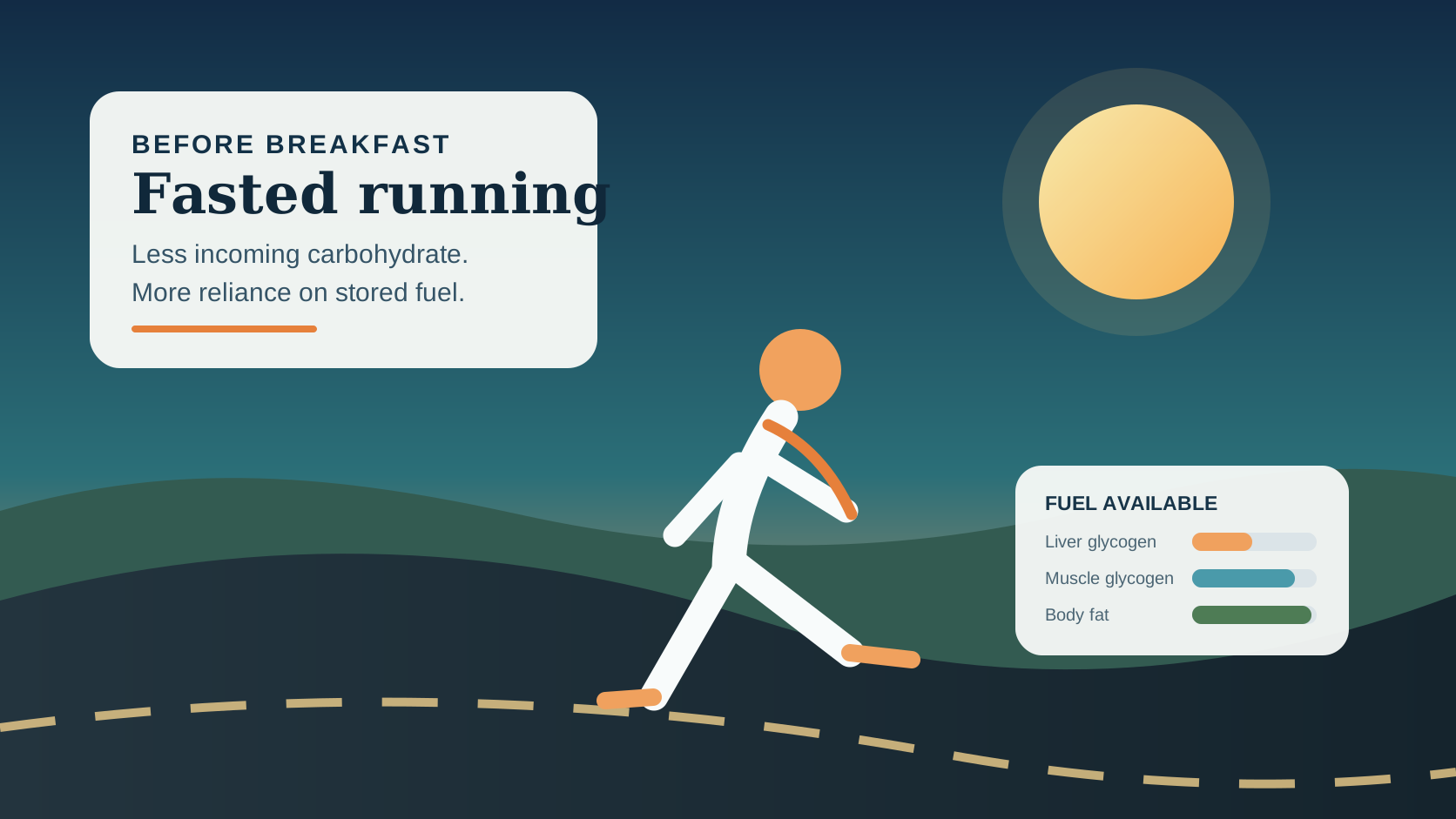
What is fasted running—and what else is it called?
In everyday use, fasted running, fasted cardio, running on an empty stomach, and running before breakfast often mean the same thing: an early run after roughly 8–12 hours without food. Water is normally allowed. Black coffee does not provide meaningful carbohydrate, although caffeine can change how the run feels.
Coaches and sports scientists may use broader terms such as train low, low-carbohydrate-availability training, carbohydrate periodisation, or glycogen-depleted training. These are related but not interchangeable:
- Overnight fasted: no breakfast before the session; liver glycogen is lower, while muscle glycogen may still be reasonably well stocked.
- Sleep low, train low: a glycogen-reducing evening workout, limited carbohydrate afterwards, then easy training the next morning. This creates a stronger restriction and is generally an advanced strategy.
- No carbohydrate during a session: a runner may start fed but deliberately delay gels or sports drink.
- Low-carbohydrate diet or intermittent fasting: longer dietary patterns that affect far more than one selected workout.
What happens in the body during a fasted run?
After an overnight fast, insulin is lower and liver glycogen has fallen as the liver releases glucose into the blood. Direct measurements in healthy adults found substantially lower morning liver glycogen while calf-muscle glycogen changed very little overnight (Iwayama and colleagues, 2021).
Once you begin running, the body still blends fuels. Muscle glycogen and blood glucose remain available, while lower insulin and the absence of a recent carbohydrate meal encourage greater mobilisation and oxidation of fatty acids. A systematic review found higher fat oxidation during fasted aerobic exercise than during fed exercise (Vieira and colleagues, 2016).
As pace rises, carbohydrate becomes increasingly valuable because it can support a higher rate of energy delivery for a given oxygen supply. That is why a gentle aerobic run may remain comfortable without breakfast while intervals, threshold work, hills, or a fast finish can feel flat.
| Fuel or signal | After an overnight fast | Practical effect |
|---|---|---|
| Liver glycogen | Lower than after eating | Less stored liver carbohydrate is available to maintain blood glucose |
| Muscle glycogen | Often largely preserved overnight | The legs still have carbohydrate reserves, especially after a normally fuelled previous day |
| Fat stores | Abundant | Easy running can draw more heavily on fat, but fat supplies energy more slowly |
| Insulin | Lower | Fat mobilisation is less suppressed than after a carbohydrate meal |
| High-intensity capacity | May be reduced | Holding quality pace can be harder as carbohydrate demand rises |
Why fasted running can feel worse than it actually is
Many runners interpret an empty-stomach sensation, morning sluggishness, or a lack of their normal pre-run routine as proof that they are “out of fuel”. For a healthy runner starting a short easy run after an ordinary evening meal, that feeling usually arrives while substantial energy remains stored as muscle glycogen and body fat. It can feel uncomfortable without being a fuel emergency.
The important distinction is between sensation and capacity. Hunger is a signal that it is time to eat, not a live fuel gauge for the leg muscles. Morning stiffness, dehydration, poor sleep, caffeine withdrawal, expectation, and a slightly lower blood-glucose contribution can all make the first kilometres feel less inviting. In some controlled short exercise studies, performance and perceived exertion were similar whether participants were fasted or fed, although responses vary (Rothschild and colleagues, 2021).
That does not mean every bad feeling should be ignored. Dizziness, confusion, shaking, faintness, unusual weakness, or a pace that keeps deteriorating are reasons to stop, eat, and reassess. The point is simply that “this feels empty” and “my body has no usable energy left” are not the same statement.
What are the possible benefits?
1. Greater fat oxidation during the run
The clearest effect is acute: at the same easy-to-moderate workload, a fasted runner generally oxidises more fat and less carbohydrate than after a carbohydrate-containing meal. This is a change in the fuel mixture for that workout. It does not automatically mean more body-fat loss across the week; long-term weight change still depends on overall energy intake and expenditure.
2. A stronger signal for selected aerobic adaptations
Low carbohydrate availability can amplify some molecular signals related to mitochondrial biogenesis and fat handling. Training studies have found changes in enzymes and proteins involved in using fat, but improved laboratory signalling is not the same as a guaranteed faster race. A meta-analysis of trained endurance athletes found no overall performance advantage from periodised carbohydrate restriction compared with training with normal carbohydrate availability (Gejl and Nybo, 2021).
3. Confidence and practical flexibility
An occasional easy run before breakfast can teach a runner that a missed snack does not ruin every short session. It can also simplify early starts when eating immediately beforehand causes discomfort. This is a convenience and confidence benefit, not a reason to avoid eating when the workout would be better with fuel.
4. Practice using a wider fuel mix
Distance runners need metabolic flexibility: the ability to use fat efficiently at easy intensities and carbohydrate rapidly when pace increases. Fasted easy running can expose the first side of that system. Well-fuelled quality workouts and practised race nutrition train the second side.
How can it help long-distance running?
Marathon and ultramarathon runners spend many hours below threshold, where fat makes a meaningful contribution to energy production. Becoming comfortable at easy effort without constant carbohydrate intake may be useful, and selected low-carbohydrate sessions may stimulate fat-handling adaptations. A six-week training study found greater muscle adaptations related to fat use in the fasted group, but both fasted and carbohydrate-fed groups improved fitness and time-trial performance similarly (Van Proeyen and colleagues, 2011).
The limitation matters just as much. Long-distance racing is not a fat-only event. The body’s carbohydrate stores are finite, carbohydrate supports faster running more economically, and pre-race and during-race carbohydrate improves prolonged performance. A review comparing fed and fasted exercise found that eating before exercise improved prolonged aerobic performance, although it made little difference to shorter aerobic tests (Aird and colleagues, 2018).
How regularly should you run fasted?
There is no evidence-based weekly number that everyone should follow, and no runner needs fasted sessions to improve. For someone who is healthy, eating enough overall, and curious about the method, this conservative progression is practical:
- Begin with one run per week for two to three weeks.
- Keep the first attempts to 20–45 minutes at conversational effort.
- If energy, mood, recovery, sleep, and later training remain normal, extend gradually toward 45–60 minutes.
- Only consider a second weekly session if it does not displace fuel from hard or long workouts.
- Avoid stacking fasted runs on consecutive days or turning the method into chronic under-fuelling.
World Athletics’ framework for periodised nutrition advises placing low-carbohydrate work in steady sessions below lactate threshold, where reduced carbohydrate is less likely to compromise duration or intensity, and warns against chronic or consecutive restriction. For most recreational runners, zero to two easy fasted runs per week is a sensible experiment range—not a target to maximise (Stellingwerff, Morton and Burke, 2019).
Which runs should be fuelled instead?
| Possible fasted session | Better fuelled |
|---|---|
| Short recovery jog | Intervals, hill repetitions, or threshold running |
| Easy conversational run | Long or progressive run with a quality finish |
| Low-stakes aerobic mileage | Race-pace rehearsal or a time trial |
| Session followed by ample recovery and breakfast | Second session of a demanding double day |
| Occasional experiment during a stable training week | Peak-volume week, illness, injury recovery, or heavy life stress |
Race-specific long runs also train the gut and the practical skill of eating while moving. Use the Long Run Fueling Guide for those sessions. If every long run is deliberately under-fuelled, you lose opportunities to practise the strategy you intend to use on race day.
How to try a fasted run safely
- Eat a normal dinner the night before; do not combine the first attempt with deliberate carbohydrate restriction.
- Choose a familiar, flat route with an easy way home.
- Drink to thirst before leaving. Take water when heat or duration calls for it.
- Keep the effort conversational and ignore normal pace expectations.
- Carry an emergency carbohydrate source, especially until you know your response.
- Eat breakfast afterwards, including carbohydrate and protein, and continue meeting the day’s energy needs.
- Track the next 24 hours: appetite, irritability, fatigue, sleep, recovery, and the quality of the next session matter more than whether one run was completed without food.
Fasted running is inappropriate or needs individual professional guidance for runners with diabetes or glucose-lowering medication, a history of disordered eating, pregnancy, adolescents with high training demands, or anyone already showing signs of low energy availability. Stop experimenting if menstrual function changes, libido falls, injuries or illness become more frequent, performance declines, or food and training rules become rigid. World Athletics identifies low energy availability as a risk to health and performance, not a badge of discipline (World Athletics nutrition consensus summary).
Fasted running FAQs
Does coffee break a fasted run?
Black coffee supplies negligible carbohydrate, so the session remains low in incoming carbohydrate. Caffeine can affect alertness, perceived effort, heart rate, and the stomach, however. Milk, sugar, syrup, or a snack make it a fed session to varying degrees—which is not a problem if that helps you train well.
Does fasted running burn more body fat?
It usually burns more fat during that run. That does not establish greater fat loss over weeks or months, because the body adjusts fuel use across the rest of the day and body-fat change depends on sustained energy balance. Choose the method for training purpose or convenience, not because one workout displays a higher fat-burning percentage.
How long is too long for a fasted run?
There is no universal cut-off, but risk and opportunity cost rise with duration. Most runners should keep deliberate fasted work short and easy, particularly at first. Runs beyond about 60–90 minutes are generally more useful as opportunities to support training quality and practise long-run fueling.
Can I take a gel if the run starts to go badly?
Yes. The session is not a purity test. Taking carbohydrate when you become dizzy, weak, confused, or unable to maintain an easy effort is the sensible decision. Note what happened and shorten or fuel the next attempt.
Will fasted running make me faster?
Possibly as one small part of a well-designed programme, but the research does not show a consistent performance advantage over well-fuelled endurance training. Consistent mileage, appropriate intensity, recovery, and carbohydrate for demanding sessions remain more important.
Sources and review
Editorial check completed by the RunCalcs Editorial Team: November 17, 2026. This article has not been medically or clinically reviewed. It provides general sports-nutrition education and is not individual medical or dietetic advice.
- Fasted-versus-fed fuel use is checked against a systematic review and meta-analysis of aerobic exercise.
- Overnight liver and muscle glycogen statements are supported by human magnetic-resonance measurements of diurnal glycogen variation.
- Performance claims are checked against a systematic review of fasted and fed exercise performance and a meta-analysis of periodised carbohydrate restriction in trained endurance athletes.
- Practical placement of low-carbohydrate sessions and cautions against chronic restriction follow the World Athletics framework for periodised nutrition.
Health-adjacent content follows the RunCalcs editorial source-check policy.
Published: November 17, 2026